The Market Stall as a Nutritional Calendar
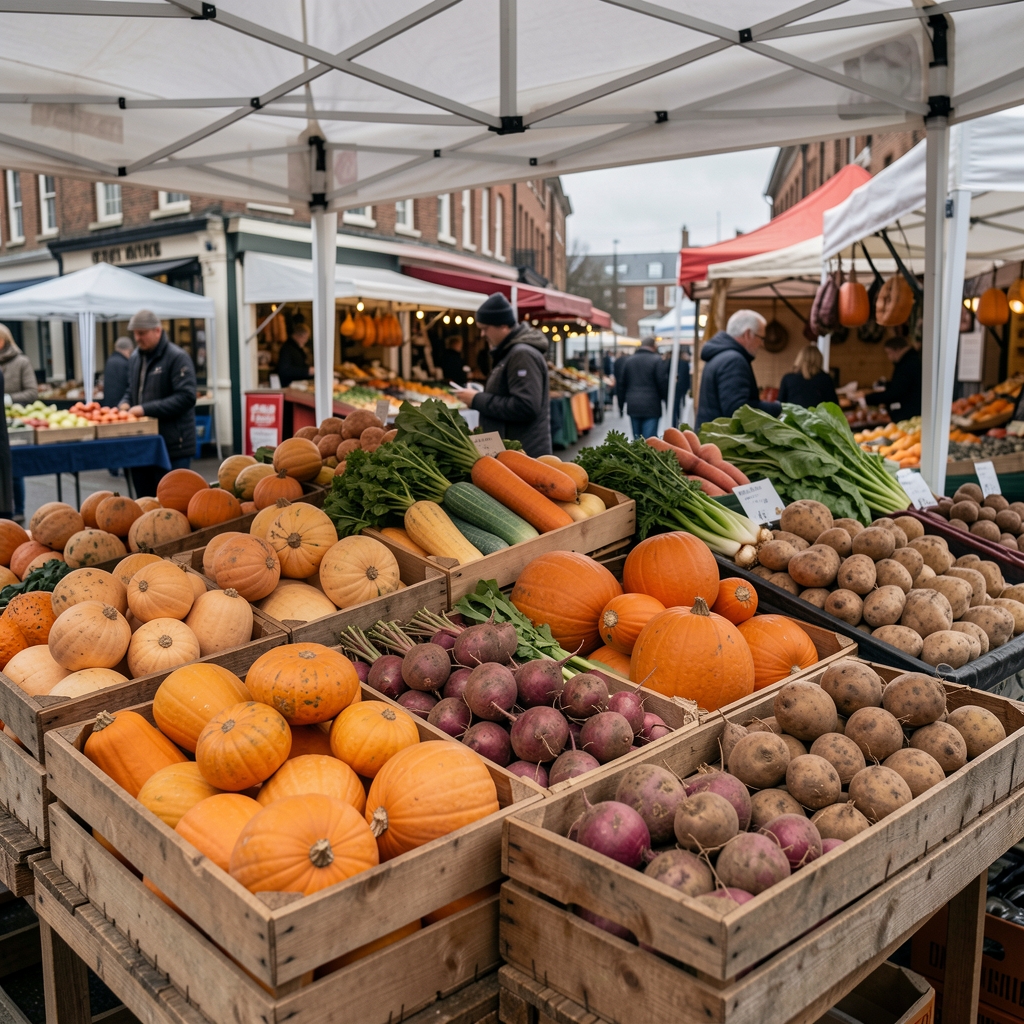
The produce available at a well-stocked market stall in London changes with a regularity that approximate seasonal calendars can predict, but individual weeks surprise. Early November brings the last of the outdoor tomatoes alongside the first serious quantities of root vegetables — celeriac, turnip, beetroot in their deeper, slower-growing forms. By December the leafy brassicas are at their densest: cavolo nero, chard, the various kales that crowd the upper shelves of the winter stall. January introduces a narrow corridor of storage vegetables — onions of every variety, squashes held since autumn, long-keeping carrots — that form the backbone of the quietest cooking months.
What this calendar produces, when followed without deliberate nutritional intent, is a diet that rotates through a wide range of phytonutrients across the winter quarter. The nutritional breadth is not achieved by planning; it is achieved by proximity to what the season provides. A cook who shops at the market twice a week and selects what looks most fresh will, across twelve weeks, have encountered a wider range of whole-food vegetables than a cook who shops once a week at a supermarket and selects from a stable, year-round range.
This observation is not a directive for market shopping over supermarket shopping. It is a note about variety as a structural outcome of seasonal availability. The season, when followed, generates variety almost automatically. The challenge of sustained nutritional variety — one of the recurring observations in diet and nutrition research — is partly solved by the calendar without requiring explicit management.
Root Vegetables and the Architecture of the Winter Plate
The winter plate, assembled from seasonal whole foods, has a characteristic architecture: a substantial base of cooked root vegetables or legumes, a smaller proportion of animal or plant protein, and whatever green is available and fresh — usually a leafy brassica or a stored allium. This architecture, which emerges from practical availability rather than nutritional planning, maps closely to the balanced meal structures recommended in standard nutritionist guidance.
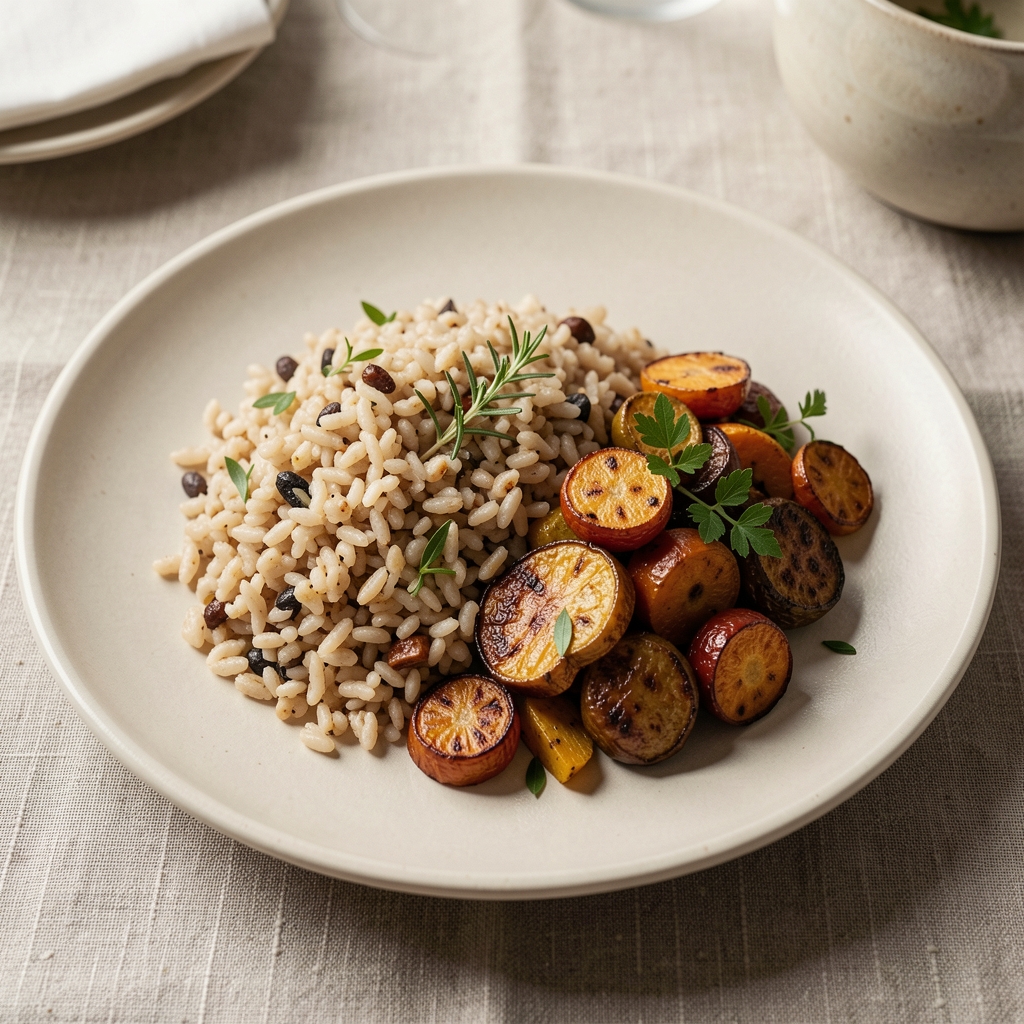
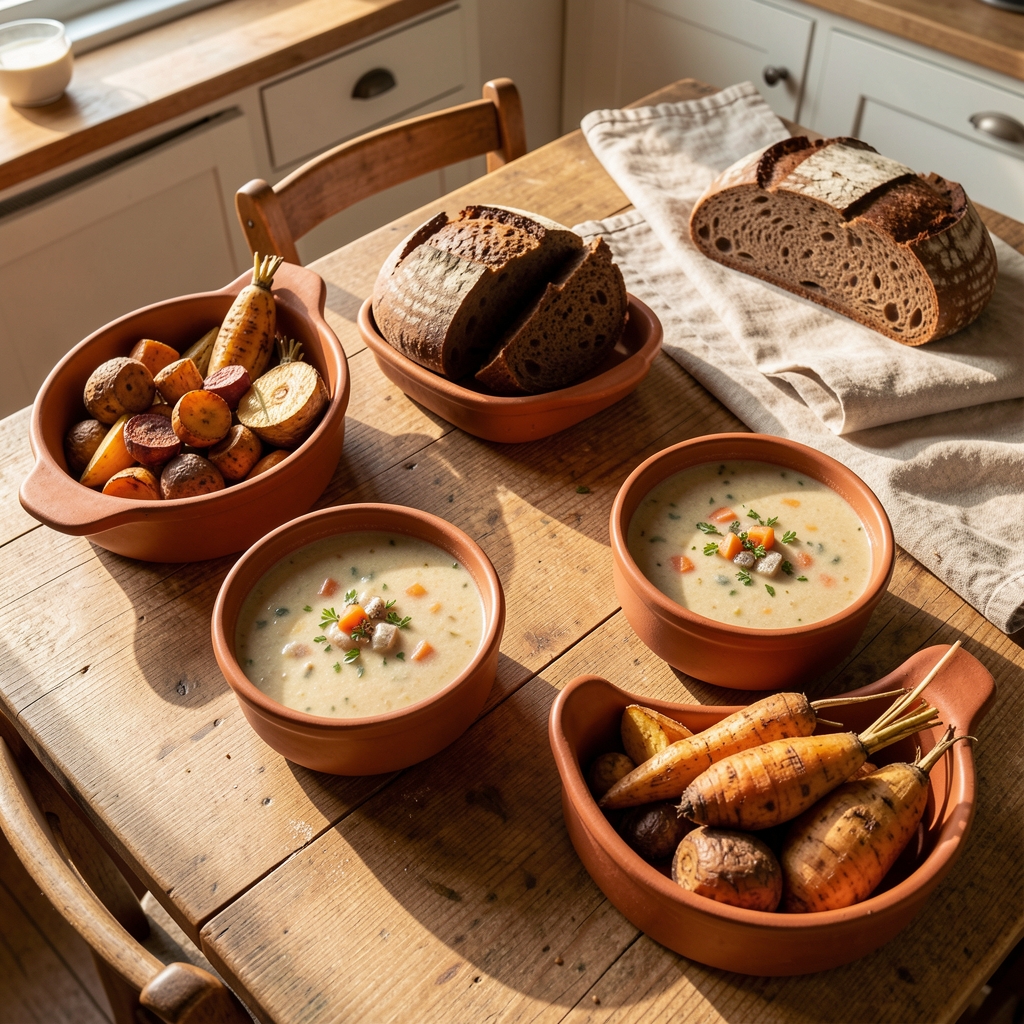
Root vegetables carry a higher carbohydrate density than summer produce, but they also carry considerable fibre — particularly when prepared without removing their skins. Parsnips, celeriac, and swede roasted with minimal fat and served alongside a leafy green constitute a nutritionally dense plate that is also inexpensive, low in preparation complexity, and satisfying at lower volume than comparable grain-based meals. The winter plate, in this sense, does a quiet nutritional job that summer cooking, with its lighter preparations and higher water-content vegetables, distributes differently.
The gut-friendly properties of this winter combination are substantial. Fermented winter vegetables — sauerkraut, kimchi made with winter cabbage, pickled beetroot — add a fermentation dimension that supports varied intestinal bacterial populations. These preparations do not require specialist knowledge; they are preserving traditions with long domestic histories in Northern European cooking that have, in recent decades, been reexamined through the lens of nutritional research on intestinal flora and everyday dietary support.
The Transition Months: February and March as Nutritional Pivot
February and March occupy a specific position in the seasonal cooking record. The winter stores are running low: stored squashes have softened, the long-keeping root vegetables have been available for four months and are beginning to feel repetitive. The first tentative signs of spring produce — purple sprouting broccoli in mid-February, early spinach in March — arrive as genuine variety rather than seasonal novelty. The cook who has been working with a narrow winter range experiences these early arrivals with a heightened attention that summer abundance rarely produces.
This transition moment is nutritionally significant. The shift from predominantly cooked, dense winter preparations to the lighter, more varied spring palette changes the macro-nutritional composition of the diet in ways that are measurable if one keeps a detailed food record. Protein sources shift slightly; fat content in cooking tends to reduce; raw preparation becomes more common. The digestive rhythm changes with it — a shift that the growing body of research on seasonal eating patterns and intestinal adaptation has begun to document with increasing specificity.
The transition months are also the period when meal planning requires the most active attention. The winter repertoire has been narrowed by repetition; the spring repertoire has not yet fully arrived. Cooks who plan meals one week at a time report this as the most challenging period for maintaining nutritional variety and keeping meals interesting. Building a small rotation of recipes that bridge the gap — hearty lentil preparations that accommodate both winter roots and early spring greens, for instance — reduces the difficulty considerably.
Whole Foods in a Seasonal Context: What Changes and What Persists
The category of whole foods, when examined seasonally, divides into two groups: those that remain available and nutritionally stable year-round — dried legumes, nuts, seeds, eggs, certain grains — and those that vary dramatically by season in quality, flavour, and nutritional density. The seasonal group is the more interesting documentary subject. A tomato in August and a tomato in February are nutritionally distinct objects; the August fruit contains substantially higher lycopene and vitamin C content. The flavour difference is the most direct signal of the nutritional difference.
Nutritionist guidance on vegetables and fruits tends to emphasise quantity — the five-a-day target, the proportion of the plate occupied by plant foods — rather than seasonal quality. The emphasis on quantity is pragmatically correct: getting adequate plant food volume is the primary challenge for most people, and the seasonal quality argument can be used as a reason to avoid vegetables entirely when the seasonal alternative is not available or affordable. But the quality dimension is real and worth documenting.
The cook who organises their vegetable purchasing around what is at its seasonal peak — by growing some, by shopping at market, by paying attention to the transition dates — will encounter a different nutritional and sensory experience than the cook who purchases the same range of vegetables year-round. Neither approach is wrong. The seasonal approach has a documentary quality that rewards attention. The year-round approach has a practical consistency that supports sustained habit. Most real eating patterns contain elements of both.
Gut-Friendly Recipes and the Fermentation Winter
Winter cooking has a particular relationship with fermentation that summer cooking does not share. The preservation imperative of pre-refrigeration cooking produced a tradition of lacto-fermented vegetables — sauerkraut, kimchi, pickled cabbage in its many national variations — that winter kitchens accumulated as a matter of practical necessity. The contemporary interest in gut-friendly recipes has reengaged this tradition from a different angle: the nutritional research on intestinal bacterial diversity and its relationship to overall dietary patterns.
The practical application of this research in a domestic kitchen does not require extensive technical knowledge. A jar of shredded cabbage and salt, left at room temperature for five to ten days, produces a fermented product with a different bacterial profile than the starting material. Incorporated regularly into meals — as a condiment alongside root vegetables, as an addition to grain bowls, as a direct accompaniment to protein — it adds a fermentation dimension to the diet without requiring specialised preparation. The documentation of this practice in a winter cooking record shows its integration into everyday meal patterns as natural and incremental rather than deliberate and effortful.
The seasonal logic here is clear: winter cabbages are at their densest and most flavourful. The cold ambient temperature of a winter kitchen supports slower, more controlled fermentation than summer conditions allow. The preservation surplus of winter root and brassica production makes fermentation a practical activity rather than an artisanal hobby. Seasonal cooking and gut-friendly practice converge in winter more naturally than in any other part of the year.
Archival Conclusions: The Season as Nutritional Structure
What the documentary record of a winter cooking season reveals, examined in full, is that the season itself functions as a nutritional structure. It narrows the range in some dimensions — there are fewer fresh fruits, fewer raw preparations, a smaller colour spectrum on the plate — while expanding it in others: fermented additions, cooked brassica variety, the deep sweetness of slow-roasted roots. It is not a nutritionally perfect structure, but it is a coherent one, and its coherence does a certain amount of work without requiring active management.
The archival approach to seasonal cooking — documenting what was available, what was selected, how it was prepared, and what the resulting nutritional record looks like across twelve weeks — is a more honest method of understanding winter diet than any instructive approach could be. Instructive seasonal eating guides assume a level of market access, culinary confidence, and time for preparation that is not evenly distributed. The documentary record shows how seasonal availability shapes eating patterns for people with varying levels of those resources — and what the shared structural patterns look like when they emerge from constraint rather than aspiration.
The quiet months between November and April are, in nutritional terms, neither a deprivation nor a challenge to be overcome. They are a distinct phase of the year's eating rhythm, with their own strengths, their own gaps, and their own characteristic flavours. Understanding them as such — rather than as a deficit version of summer — is the precondition for cooking through them well.
- Seasonal availability generates nutritional variety across a winter quarter without requiring active planning, provided the cook is responsive to what is fresh and present.
- Root vegetables and winter brassicas form a nutritionally dense plate architecture that maps closely to balanced meal structures in standard nutritional guidance.
- February and March represent the most challenging transition period for maintaining dietary variety, as winter stores narrow and early spring produce has not yet arrived in volume.
- Winter fermentation — sauerkraut, pickled brassicas, lacto-fermented vegetables — integrates gut-friendly preparation into seasonal cooking practice as a natural rather than deliberate addition.
- The seasonal approach to whole-food selection produces higher nutritional density in the vegetables consumed, with peak-season produce showing measurably higher key nutrient content than year-round equivalents.